Myo-Reps in OpenLift: Short Rests, Clear Mini-Sets, Better Set Structure

Some sets are not just one effort. They are a structure.
Myo-Reps are built around that idea: one activation set, then several short mini-sets with brief rests between them. The method can be useful, but it is easy to lose track of the plan when you are training hard.
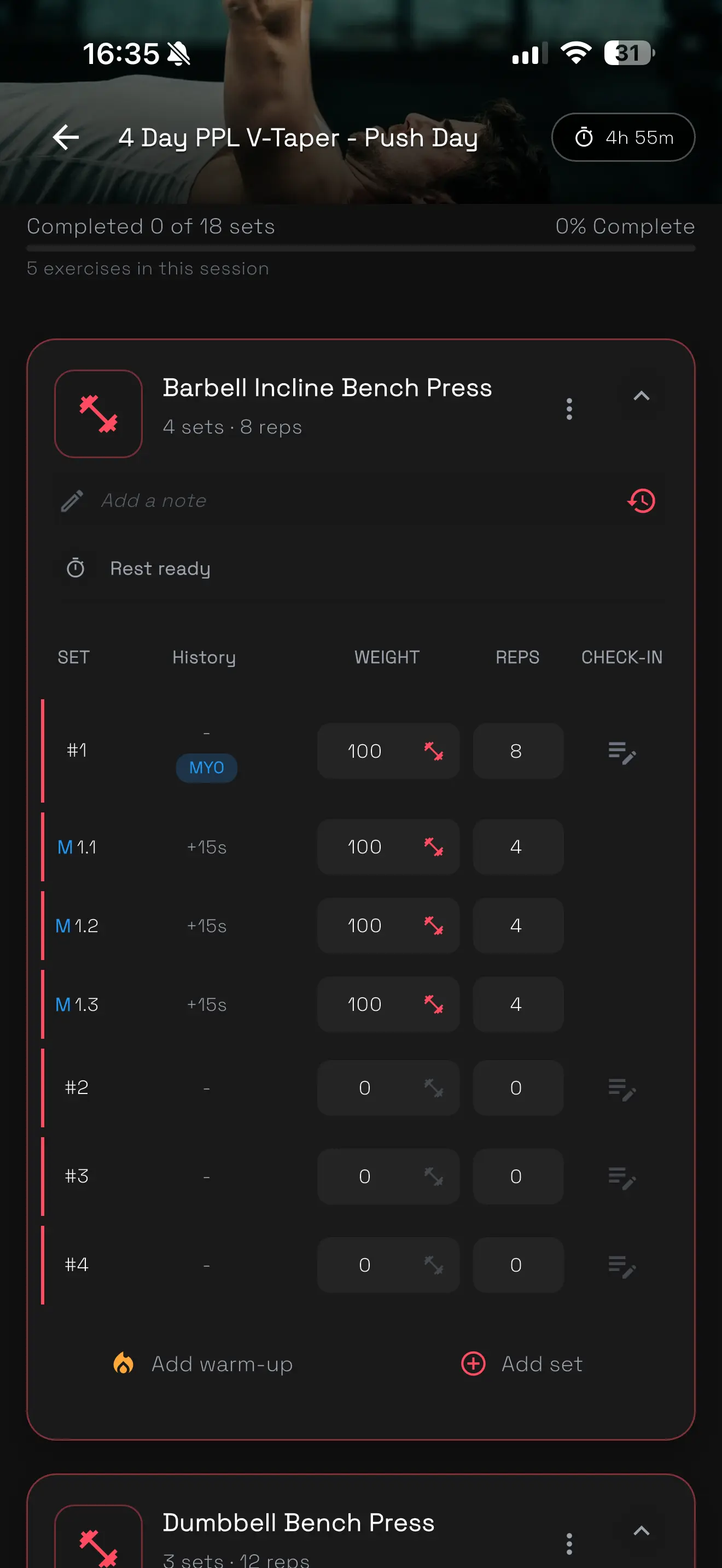
OpenLift now supports Myo-Reps directly inside the Set Tracker, so the activation set, mini-sets, and short rests stay visible in one clean sequence.
What Myo-Reps are trying to do
Myo-Reps are a way to collect more high-effort reps without doing several full traditional sets.
You start with an activation set. That set brings the target muscle close to fatigue. Then you use short rests and small mini-sets to keep the work dense while the muscle is still under meaningful fatigue.
For example, you might perform 12 activation reps, rest 15 seconds, then do 3 mini-sets of 4 reps with 15 seconds between each one.
The goal is not to make every exercise harder for no reason. The goal is to get more quality work from a focused exercise without turning the session into a long sequence of repeated setup sets.
Why Myo-Reps need a clear tracker
Myo-Reps are simple on paper, but they are annoying to track manually.
You have to remember the activation target, the mini-set reps, how many mini-sets are left, and the rest time between each cluster. If the app only gives you normal set rows, the structure gets buried.
That is exactly the kind of training detail OpenLift should handle for you.
How OpenLift sets up Myo-Reps
In OpenLift, Myo-Reps are added to a working set through a dedicated setup flow. You choose the structure once, then the Set Tracker lays out the sequence.
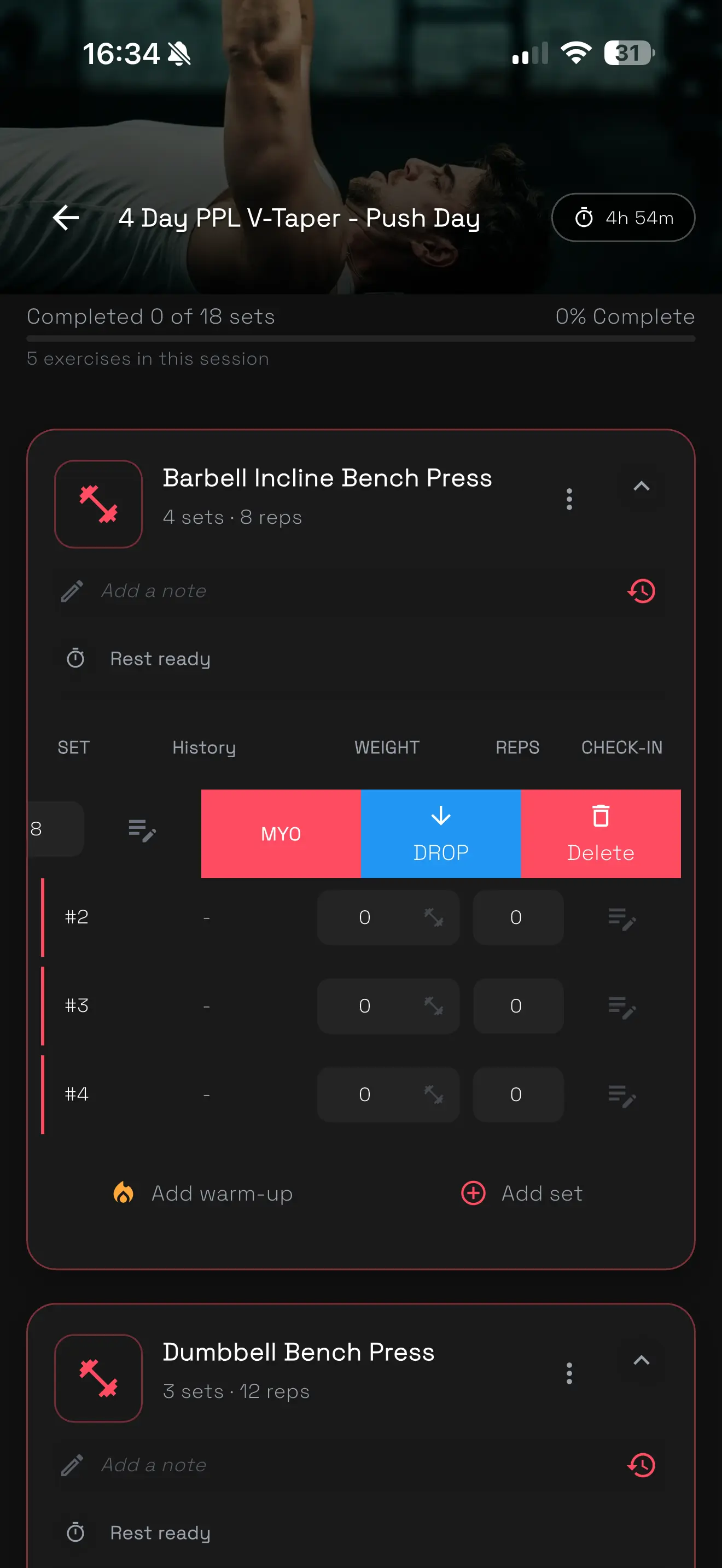
The setup includes:
- activation reps;
- reps per mini-set;
- number of mini-sets;
- rest between mini-sets.
The default values are practical:
- activation reps: the actual reps in the set, if available; otherwise the target reps; otherwise 10;
- mini-set reps: 4;
- mini-sets: 3;
- mini-set rest: 15 seconds.
OpenLift also keeps the inputs inside useful ranges:
- activation reps can be 1-50;
- mini-set reps can be 1-20;
- mini-sets can be 1-6;
- mini-set rest can be 5-90 seconds.
All Myo-Reps segments use the same weight as the main set. The mini-set rows are labeled with the short rest, such as +15s, so it is clear that this is one advanced set structure, not several unrelated sets.
What Myo-Reps are good for
Myo-Reps are useful when you want a dense block of work with short rests.
They often fit well on exercises where setup is simple and technique stays stable under fatigue. Machines, cables, dumbbell accessories, and isolation movements are usually better candidates than heavy technical lifts.
Myo-Reps can be useful when:
- you are short on time but still want meaningful accessory work;
- you want repeated hard reps without several full rest periods;
- the exercise is safe and consistent under fatigue;
- you want the log to show the activation set and mini-sets as one planned structure.
The main benefit is organization. You do not have to remember how many mini-sets are left or whether the rest should be 15 seconds. The plan stays visible while you train.
When not to use Myo-Reps
Myo-Reps are not the right tool for every exercise.
If a movement requires heavy bracing, balance, or precise technique, very short rests can make quality drop quickly. In those cases, straight sets with normal rest usually make more sense.
They are also not a replacement for basic progression. If your training is already inconsistent, adding mini-set complexity will not fix the foundation.
For most lifters, the safest approach is to start with one Myo-Reps structure near the end of a workout, then review how it affected performance and recovery.
Why OpenLift treats it as one structure
The most important product decision is that Myo-Reps stay grouped.
The activation set and mini-sets belong together. If they are logged as normal separate sets, the workout history loses context. You can still see the numbers, but you cannot easily see the method.
OpenLift keeps the method attached to the work:
- one activation effort;
- visible short-rest mini-sets;
- consistent weight;
- clear labels;
- no mixing with another advanced technique on the same set.
That makes the workout easier to follow during the session and easier to review later.
Final thought
Myo-Reps can be useful when you want concentrated work without a long chain of normal sets.
OpenLift makes the method easier to apply by turning the structure into something visible, editable, and readable inside the Set Tracker.
Less remembering. Less manual tracking. More attention on the reps you actually perform.
Check the full OpenLift changelog to see the rest of the release.