Drop Sets in OpenLift: More Work After the Main Set, Without the Math

Sometimes one hard set is not quite enough, but adding more full sets is not the right answer either.
That is where Drop Sets can be useful. You complete the main working set, reduce the load quickly, and continue with more reps while the target muscle is already fatigued.
OpenLift now supports Drop Sets directly inside the Set Tracker, so you can use the technique without calculating load drops, creating separate random sets, or losing the intent of the work.
What a Drop Set is trying to do
A Drop Set is a simple intensity technique: perform a working set, lower the weight, then keep going.
The idea is not that Drop Sets are magic. The idea is that they can help you collect more local muscle work in less time, especially when the goal is hypertrophy or focused accessory training.
For example, you might press 100 kg for 8 reps, then immediately reduce the weight and continue. The lighter follow-up segments let you keep training the same movement pattern after the main set has become too hard.
Used well, Drop Sets create density. Used everywhere, they create noise and fatigue.
Why logging Drop Sets usually gets messy
Most workout logs treat every row as a normal set.
That works fine until one set becomes a sequence: main set, first drop, second drop. If those are logged as three unrelated sets, the history no longer shows what actually happened.
The problem is not only visual. When you review the workout later, you want to know that this was one hard set with drop extensions, not three straight sets with strange weight changes.
Good training data should preserve intent.
How OpenLift structures Drop Sets
In OpenLift, a Drop Set starts from an existing working set. The main set becomes the parent, and the drop segments stay underneath it.
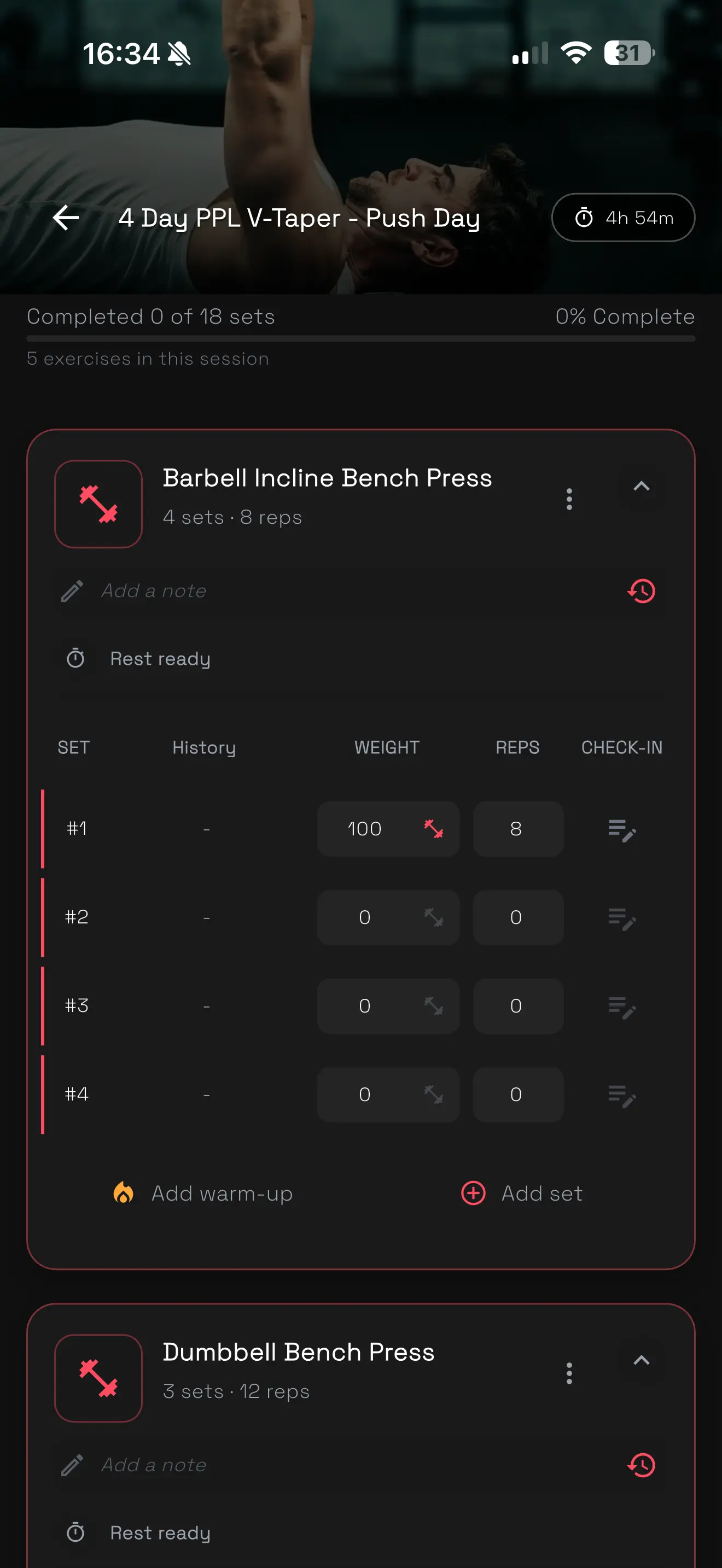
The rules are intentionally clear:
- Drop Sets can only be added to working sets, not warm-up sets.
- A set cannot mix Drop Sets with another advanced technique.
- The original working set becomes the container.
- The first segment keeps the actual weight and reps from the main set.
- OpenLift adds up to two drop segments underneath it.
- The first drop starts around 20 percent lower than the main set.
- The second drop starts around 15 percent lower than the previous drop.
- Suggested weights are rounded to the nearest 0.5 units.
- Drop segment reps start at 0, so you record what you actually performed.
For example, if you complete 100 kg for 8 reps and add a Drop Set, OpenLift can suggest follow-up segments around 80 kg and 68 kg.
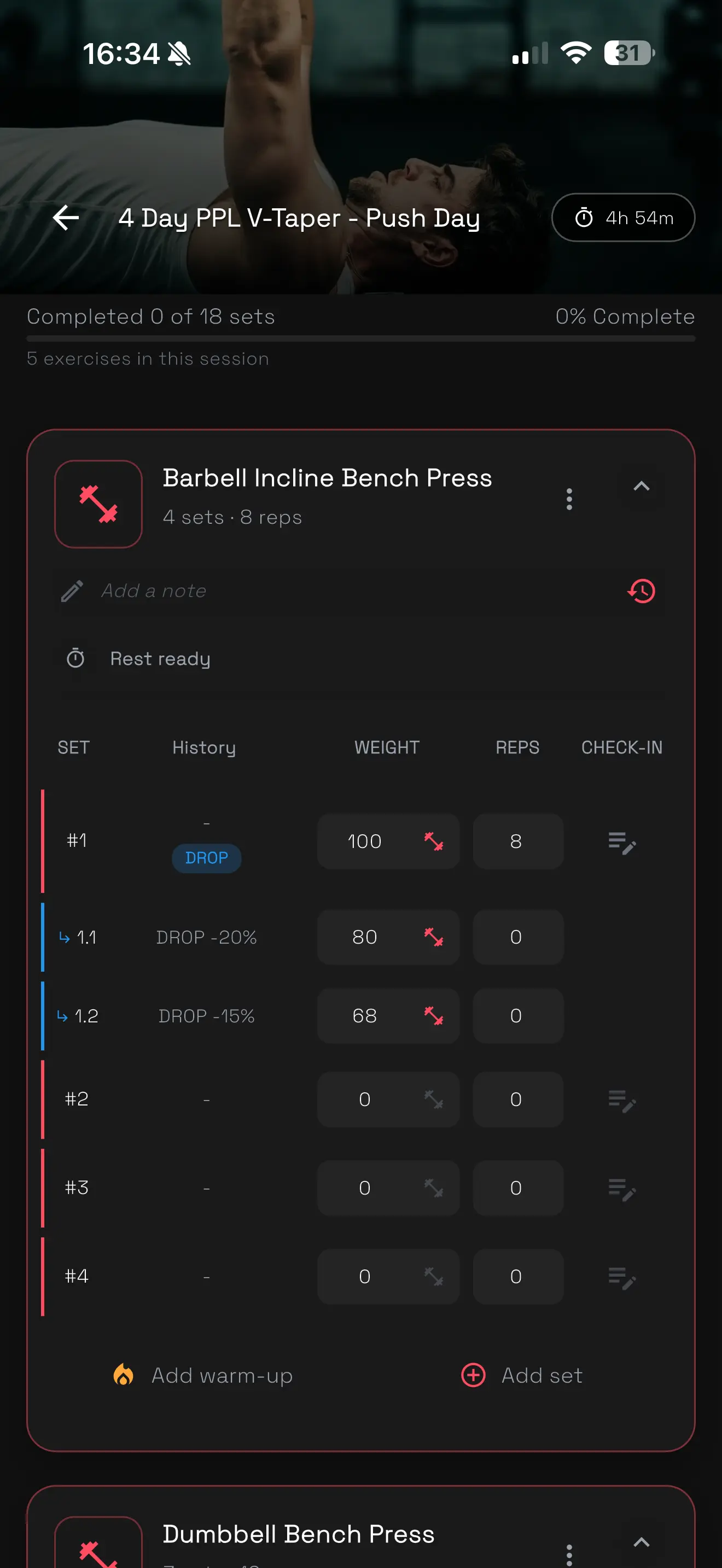
You still record the real reps after each drop. OpenLift just removes the mid-workout math and keeps the structure readable.
What Drop Sets are good for
Drop Sets are most useful when the goal is more local work, not more maximal strength practice.
They often fit well on machine exercises, cable movements, dumbbell accessories, and isolation work. These are exercises where reducing the load is quick, safe, and does not require a full reset.
A Drop Set can be useful when:
- you want more work from one exercise without adding a long block of extra sets;
- you are near the end of a session and want a focused finisher;
- you are training an accessory movement where form stays stable under fatigue;
- you want a clear way to record intensity work without cluttering the log.
For most lifters, Drop Sets work best as a targeted tool. One or two exercises is usually enough.
When not to use Drop Sets
There are times when a normal set is the better choice.
If you are learning a movement, keep the structure simple. If form is already breaking down, reducing the load and continuing may add fatigue without adding better training.
Drop Sets are also not ideal for every heavy compound lift. Squats, deadlifts, and technically demanding movements can become risky or sloppy when fatigue rises quickly.
The practical rule is simple: use Drop Sets where the exercise is stable, the target is clear, and the extra fatigue is recoverable.
What this means in your workout
This update is about reducing friction at the exact moment where friction usually gets in the way.
You should not need to stop and calculate a 20 percent weight reduction. You should not need to create separate fake sets. You should not need to remember whether the second drop was supposed to be 15 percent lower or something else.
OpenLift handles the structure:
- choose a working set;
- add Drop Set;
- follow the suggested drops;
- record the reps you actually completed.
The result is a cleaner workout flow and a clearer training history.
Final thought
Drop Sets are useful because they let you extend a hard set without turning the whole session into more straight sets.
OpenLift makes that practical by keeping the main set, drop segments, weights, and actual reps connected in one readable structure.
More focused work when you need it. Less math when you are tired.
Check the full OpenLift changelog to see the rest of the release.